
The Real Problem with Market Research
Market research is often described as time-consuming and complex.
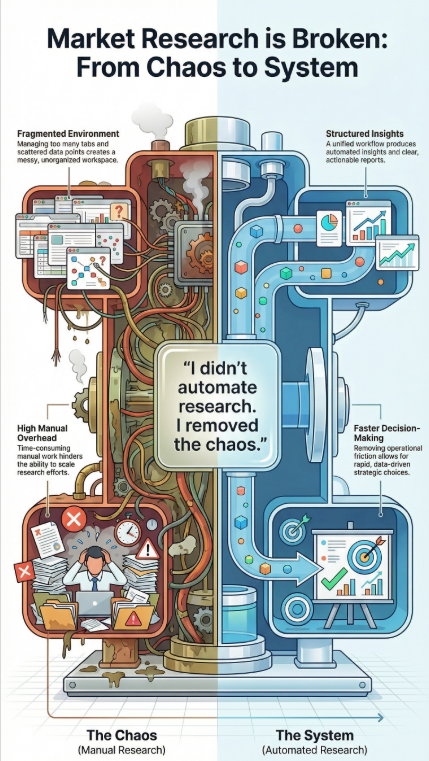
But in reality, the challenge is not complexity; it is the lack of structure.
Most research processes look like this:
- Opening multiple browser tabs
- Searching for competitors
- Scanning through different sources
- Manually collecting and organizing data
This leads to two major issues:
First, a significant amount of time is spent on repetitive tasks such as searching, copying, and organising information.
Second, even after collecting large amounts of data, it is still difficult to extract clear insights.
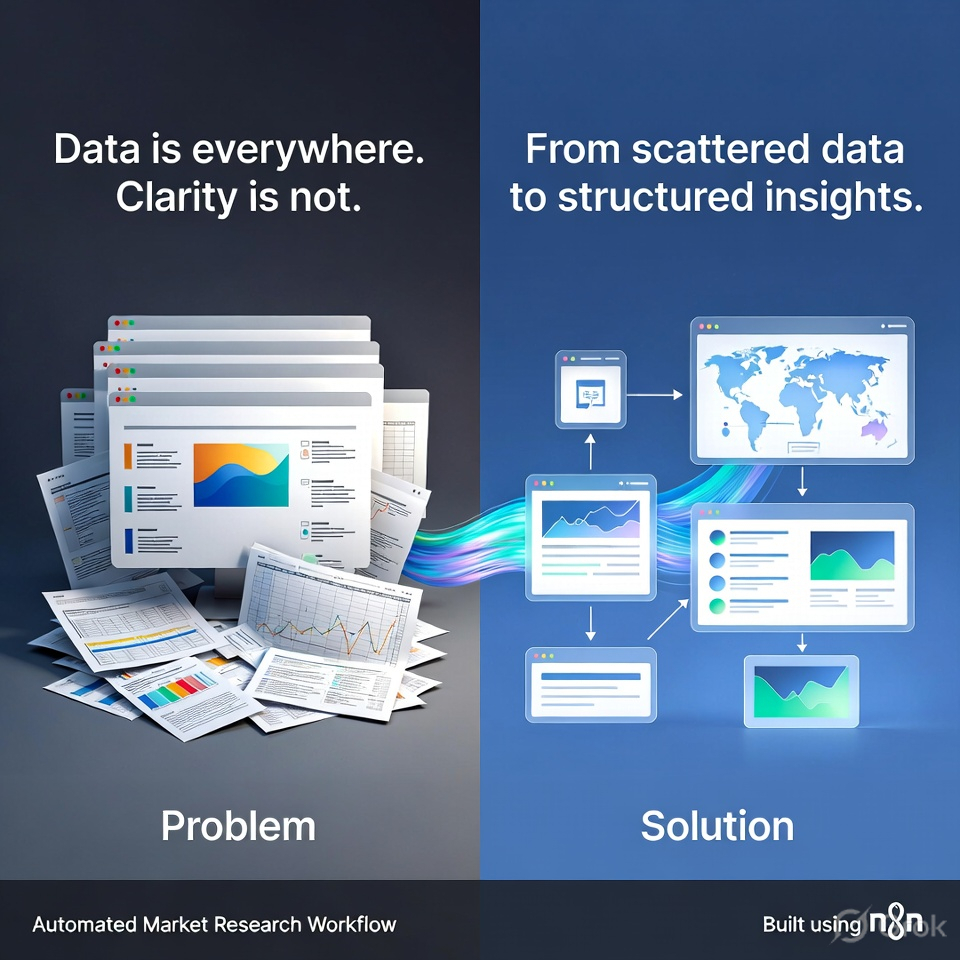
In simple terms, data is easily available, but clarity is not.
This gap between data and insight is what makes market research inefficient.
Why I Decided to Build a Workflow
At one point, I noticed that every time I started research, the process remained the same:
- The same steps
- The same effort
- The same inefficiencies
Improving effort did not solve the problem.
So I decided to improve the system instead.
The goal was not just to save time but to create a structured approach where:
- Data flows in an organized way
- Insights are easier to identify
- Decision-making becomes faster
This led me to build an automated workflow.
Why I Used n8n?
To implement this system, I used n8n, a workflow automation platform that allows different steps to be connected into a single process.
Instead of performing each task manually, the workflow executes them in sequence.
The reason for choosing n8n was not just automation capability but also flexibility:
- It allows integration of multiple data sources
- It supports step-by-step process building
- It helps convert repetitive tasks into a structured flow
More importantly, it enabled me to design a system that mirrors how research should ideally happen.
To implement this system, I used n8n, a workflow automation platform that allows different steps to be connected into a single process.
Instead of performing each task manually, the workflow executes them in sequence.
The reason for choosing n8n was not just automation capability but also flexibility:
- It allows integration of multiple data sources
- It supports step-by-step process building
- It helps convert repetitive tasks into a structured flow
More importantly, it enabled me to design a system that mirrors how research should ideally happen.
How the Workflow Solves the Core Problem
The workflow directly addresses the two main challenges of market research: lack of structure and time inefficiency.
Structured Data Collection
Instead of manually searching across platforms, the workflow gathers relevant data automatically.
This ensures:
- Consistency in the type of data collected
- Elimination of repetitive searching
- Faster access to relevant information
Time that was previously spent on finding data is now saved.
Automated Competitor Analysis
The workflow processes competitor information to identify:
- Content focus areas
- Positioning strategies
- Gaps and opportunities
This removes the need to manually compare multiple competitors and helps generate a clearer market view.
Insight Generation Instead of Raw Data
One of the biggest improvements is the transition from raw data to structured insights.
Instead of reviewing scattered information, the workflow organises the following:
- Patterns
- Trends
- Key observations
This reduces cognitive load and makes analysis more efficient.
Report Creation and Output
The final step converts all processed information into a structured report.
The output is:
- Clearly organized
- Easy to interpret
- Ready for action
This eliminates the need for manual summarisation and formatting.
How It Saves Time
The time-saving impact of this workflow comes from eliminating repetition.
Before automation:
- Time was spent searching for data
- Time was spent switching between tools
- Time was spent organizing and formatting information
After automation:
- Data is collected automatically
- Analysis is partially processed
- Outputs are structured
This reduces the overall research time significantly and allows more time for meaningful work.
From Data Collection to Decision-Making
The most important change is not speed; it is the shift in focus.
Previously, most of the effort was spent on:
- Collecting data
- Managing information
Now, the focus is on:
- Interpreting insights
- Identifying opportunities
- Making decisions
This shift improves the quality of outcomes.
When the process is structured, decisions become the following:
- Faster
- More confident
- More data-driven
What This Workflow Changed for Me
This workflow transformed how I approach research in three ways:
-First, it reduced manual effort by automating repetitive tasks.
-Second, it improved clarity by structuring information into insights.
-Third, it enabled better decision-making by making insights easier to understand and act upon.
The result is not just efficiency, but improved effectiveness.
Final Thoughts
Market research does not require more data.
It requires better systems.
Automation, when applied correctly, does not replace thinking.
It supports it.
By structuring workflows:
- Time is saved
- Effort is reduced
- Insights become clearer
- Decisions improve
The real advantage is not in using tools, but in building systems that make work more meaningful.
To read more about SEO and market updates, visit its.kavya.in