
SEO has changed over the last few years; digital marketing agencies have multiplied rapidly. Every agency promises higher rankings, more traffic, and better visibility. But in 2026, especially in the B2B market, businesses are asking a different question:
“Will this generate revenue?”
The shift is no longer about visibility. It is about measurable ROI.
The Saturation Problem in Digital Marketing Agencies
The agency market is not saturated because there are too many marketers.
It is saturated because too many agencies are selling the same metric:
- Page 1 rankings
- Organic traffic growth
- Keyword volume
But B2B businesses do not operate on traffic. They operate on pipeline and revenue.
A website ranking first means nothing if:
- The traffic is not decision-makers
- Visitors do not convert
- Leads are unqualified
- Sales cycles remain unchanged
Ranking is visibility. Revenue is survival.
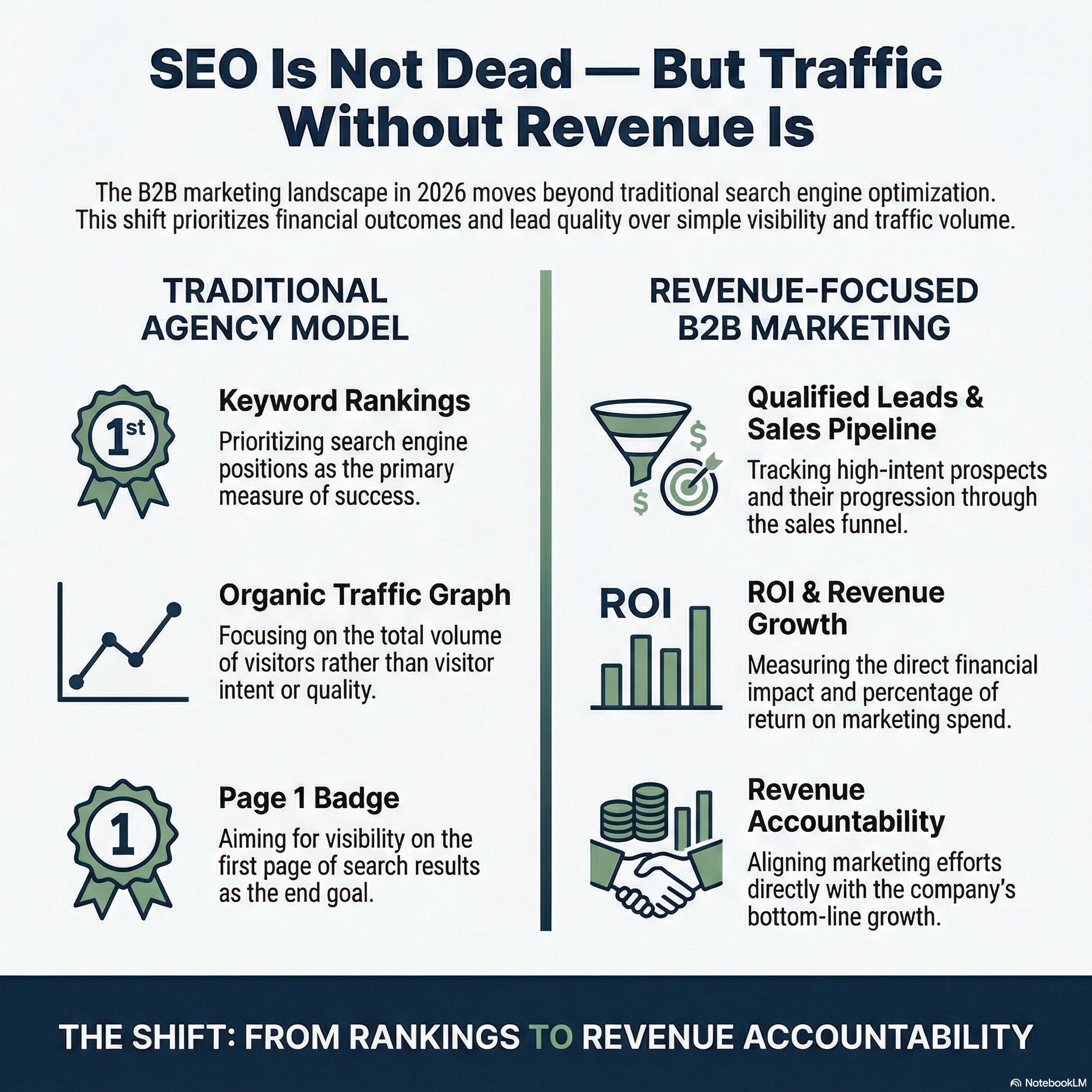
The B2B Shift: From Inbound Vanity to Revenue Accountability
In B2B markets, buying decisions are complex. They involve:
- Multiple stakeholders
- Longer sales cycles
- High-ticket investments
This means businesses now prioritize:
- Lead quality over traffic quantity
- Conversion rate over impressions
- ROI over keyword position
As a result, performance marketing and revenue-based strategies have gained attention.
Outbound strategies, paid campaigns, and account-based targeting are being prioritized because they create predictable pipelines.
Inbound marketing is no longer enough on its own.
Has Search Changed? Yes.
Search behavior in 2026 is not the same as it was in 2020.
With the rise of large language models and AI-powered assistants, users are shifting from traditional search engines to conversational platforms for information discovery.
This does not mean SEO is dead.
It means SEO must evolve.
Businesses must now focus on:
- Search intent precision
- Topic authority
- Experience-driven content
- Multi-platform visibility
Simply optimizing keywords is outdated.
The Real Issue: SEO Without Revenue Alignment
The biggest mistake agencies make is treating SEO as a traffic channel rather than a revenue channel.
If after 3–6 months of consistent SEO efforts:
- There are no qualified leads
- There is no improvement in conversion quality
- Sales teams see no pipeline impact
Then the strategy is incomplete.
SEO should attract the right audience — not just more audience.

The Paid Ads Dilemma
Some businesses react to poor SEO performance by immediately increasing ad spend. However, running aggressive paid campaigns without a solid organic strategy can backfire over time.
In the long run, over‑reliance on paid ads can:
- Increase dependency on ads, making it harder to generate leads without constantly paying for clicks.
- Erode credibility, as users generally trust organic results more than sponsored ones and may perceive “always-on” ads as less authentic.
- Reduce long-term sustainability, because rising CPCs and ad fatigue push acquisition costs up while performance goes down.
- Create inconsistent cost-per-lead metrics, especially when campaigns are pausing, scaling, and competing with algorithm changes on ad platforms.
- Harm user experience if the website becomes too ad-centric (pop-ups, banners, aggressive CTAs), which increases bounce rates and damages brand trust.
- Undermine organic visibility indirectly, since slow, ad-heavy pages and poor engagement can hurt search performance over time.
User behavior and recent platform updates also show a clear trust gap:
- Nearly half of users say they trust organic results more than paid results, and “too many ads” is a top frustration in search.
- Studies on click behavior consistently show that organic listings attract a much larger share of clicks than paid ads, mainly because people feel organic results are “earned,” not bought.
- Google is making sponsored content more obvious and even allowing users to hide sponsored sections, which further separates “ads” from “real results” in the user’s mind.
SEO builds long-term authority, trust, and discoverability.
Paid ads create speed, testing velocity, and precise targeting.
They should not compete; they should complement each other. Use paid campaigns to support and accelerate an organic strategy—not to compensate for the lack of one.
The New B2B Marketing Reality
Modern B2B marketing is moving toward:
- Revenue-based accountability
- Sales and marketing alignment
- Account-based approaches
- Data-driven performance tracking
Outbound is rising.
Inbound must become smarter.
The agencies that survive will not be those that promise rankings.
They will be those that connect search visibility to measurable business growth.
Final Thought
SEO is not dead.
But SEO that ignores lead quality, conversion intent, and revenue contribution is outdated.
In 2026 and beyond, marketing success will not be measured by where you rank — but by what you generate.
Visibility is important.
Revenue is essential.
To know more about AI SEO and to read more, click here